
1927 Newspaper Reports Regarding The Star of Greece and The Nashwauk Shipwrecks (& Nashwauk’s Anchor)
I recently discovered that page 1 of “The Mail” newspaper of Saturday 20th August 1927 featured a report about A “Mysterious Anchor on (the) Beach at Moana”: -
“OLD WRECK RECALLED
Lying on the beach at Moana, the recently named seaside resort south of Port Noarlunga, is a large ship's anchor, once probably a part of the sailing ship Nashwauk, which was wrecked in the vicinity on May 13, 1855.

The Nashwauk was a sailing ship between 700 and 800 tons, which left Liverpool on February 13, 1855, with 300 immigrants, including 130 single girls, on board.
It is believed, though it is not definitely known, that her skipper, Capt. Mclntyre, early on Sunday morning, May 13, 1855, mistook the light of Harriott's farmhouse, situated on the cliffs, two miles south of Port Noarlunga, for the lightship off Semaphore, and before he could rectify his error his vessel was hard and fast upon the rocks a few yards from the shore.
Messages reached Port Noarlunga that the Nashwauk was in difficulties. She was stuck in two fathoms of water, and arrangements were soon made to land passengers and crew, all of whom arrived safely at Port Noarlunga before nightfall. To feed the shipwrecked it is recorded that from eight to 10 sheep were killed, and buckets of tea were made and consumed. Many of the emigrants were subsequently taken aboard the steamer Melbourne, which had anchored off Port Noarlunga, to render assistance, while some of them found employment in the surrounding district.
The actual cause of the wreck of the Nashwauk has always been something of a mystery, but it is fairly certain that the vessel was not driven ashore. "The Register" of May 15, 1855, records the fact that the morning on which the Nashwauk went ashore off Harriott's farm was not rough, and also points out that three women, two of whom when landed were found to be suffering from fever, and one suffering from an injury apparently received while escaping from the doomed vessel, were attended by a local doctor, because the ship's surgeon, being in a state of intoxication, was unfit for duty.
An effort to ascertain whether the anchor now lying on the beach at Moana was that of the ill-fated Nashwauk was only partly successful. Mr. Walter Malpas, whose father lived at Port Noarlunga in the early days of the State, and who himself for years lived a few miles from where the Nashwauk was wrecked, said that though he could not say for certain, it was probably that the anchor lying upon the beach at Moana belonged to that ill-fated- vessel. About 35 years ago, he remembered a four-masted sailing ship being anchored close to the shore near that part of the coast now known as Moana, but he did not think that that vessel had to abandon its anchor.
The Nashwauk, he said, went to pieces in the surf, and he remembered his father, when telling the story of the wreck, saying that she was manned with a Chinese crew. He had never seen the anchor or heard of its existence, and was of the opinion that it had only recently become uncovered.”
The story was followed up in “The Mail” of Saturday 27th August 1927: -
“MOANA MYSTERY EXPLAINED
New Light on Old-time Wrecks
NASHWAUK-AND STAR OF GREECE
In the last issue of "The Mail" reference was made to a ship's anchor, lying mysteriously upon the beach at Moana, the recently named seaside resort south of Port Noarlunga.
This, week, it is possible to give a solution of the mystery, and also to throw some new light upon two old-time South Australian shipwrecks, that of the Nashwauk and the Star of Greece.
It is beyond doubt that the anchor, lying a few feet above high-water mark, at Moana, is that of the ship Nashwauk, which was wrecked in the vicinity on May 13, 1855.
Mr. W. C. Robinson, who owns and works a farm close to the place where the Nashwauk met her fate, explained how the 11 ft. anchor of the ill-starred vessel came to be lying several, hundreds of yards from the spot where the distraught crew of that ship threw it more than 72 years ago.

He was able to explain the mystery, because he, with his brother and son, removed it from its original resting place and dragged it to its present position out of reach of the sea.
Mr. Robinson said that one day in about every two years the anchor of the Nashwauk used to become visible about 50 yards from the shore off Moana, and when, in May of this year (1927), he noticed the anchor showing, he decided that he would endeavour to reclaim it. With his brother and son and three horses he set about the task, and after five or six hours of strenuous effort was successful.
The anchor of the Nashwauk is 11. ft. long and weighs several tons, but Lake Beach Estate, Limited, which is developing Moana, has decided to transport it another hundred yards, and set it upon a pedestal to remain a link with history for all time. A concrete base to take the huge anchor has already been constructed.

The Nashauk's anchor about that time

The Nashwauk's anchor in recent times
LAUGHTER AND TRAGEDY
From Mr. William Giles, who was on the beach at Moana, or Harriott's Creek, as it was then called, a few, hours after the Nashwauk struck on Sunday morning, May 13, 1855, and who is now 91 years old, the story of the old-time disaster was obtained.
The father of William Giles settled on a small farm at Morphett Vale in 1845, his son then being a youngster of 10. At daybreak on the morning of May 13, 1855, William Giles, then a young man, was riding into the township of Morphett Vale when a man overtook him galloping from the direction of Port-Noarlunga.
"Where's the police station, boy?" this individual said. "Over there." said young Giles, pointing, and almost in the same breath, "Why?" "There's a vessel ashore off Harriott's Creek. with a load of emigrants on board." said the rider, and spurred off for help.
Young Giles also spurred away, first to tell his father, and then hurriedly to put a horse in the family gig and drive pell mell (in mingled confusion or disorder, in confused haste) across country to the wreck. When they arrived at Harriott's Creek, however, they were somewhat surprised to find, instead of a scene of tragedy and danger, one of hilarity and diversion.
The Nashwauk was a tragic enough picture, stuck fast upon the sandy beach a few yards from the shore, but there was more diversion than danger among the passengers and crew, who were coming ashore when James and William Giles arrived.
Sailors, somewhat far gone in rum, were staggering ashore through a mild surf, with emigrant girls upon their shoulders, and there was high revelry among participants and spectators when every now and again carrier and carried disappeared temporarily beneath the waves. Shouting, swearing, crying, and laughing, every man and woman of the Nashwauk escaped to safety, but there was more laughter than tears about the whole affair.
LURED TO HER DOOM
Mr. Giles on Thursday, 72 years after the event, told for "The Mail" the story of the Nashwauk coming ashore in a calm, sea off Harriott's Creek. It was said at the time, he explained, that the Nashwauk mistook the light of a farmhouse for that of the beacon light at the Semaphore.
When the Nashwauk was wrecked tales were told of a farmhouse in the vicinity being the headquarters of a gang of smugglers, who, from a watchtower in the farmhouse roof, used to wave a light to guide ships into the nearby cove. Whether the Nashwauk was in league with the smugglers or whether she mistook their waving light for that of the lightship at Semaphore is not known, but it is the accepted theory of Mr. Giles that the smugglers' light lured the Nashwauk to her doom.
A few hundred yards from where the last relic of the Nashwauk is now lying there is a farmhouse, which answers the description of the smugglers' den of Mr. Giles' tale. Deserted now, it faces the sea, and nestling close beneath its roof is a tiny lookout, nailed over, but still eloquent in the light of ancient events.
Underneath this deserted farmhouse, as further testimony to Mr. Giles' story of how the Nashwauk came to be wrecked there are large, roomy cellars, out of all proportion to the requirements of an ordinary farmhouse.
STAR OF GREECE
A few miles south of where the Nashwauk was wrecked another sea tragedy was enacted 33 years later, and at this tragedy Mr. Giles was also present.
In July, 1888, William Giles was living within sight of the sea at Aldinga. The early morning of July 13 of that year was the most terrible in his memory, and when news was brought to Aldinga at daybreak that a ship, Star of Greece, was hard and fast upon a mud bar about 100 yards from the shore off Port Willunga, it was a startled and anxious little community which gathered on the beach, to render what assistance it could.
William Giles was one of the first men upon the scene. The Star of Greece had struck a mud bar with her bow, and the middle of the vessel breaking, the aft part had immediately sunk in deep water. Capt. Harrower was in that portion of the ship when she struck, and he was drowned. The rest of the crew were in quarters in the forecastle, and if they had decided to stay on the doomed boat it is doubtful whether any life other than that of the captain would have been lost. Instead, most of the crew elected to try to swim ashore, and 10 of them perished.
It has been stated that one spectator swam through the terrible surf to the Star of Greece, but Mr. Giles, who was present, maintains that nobody reached the wreck from the shore. Mr. Charles Addison, according to Mr. Giles, made a valiant attempt to reach the vessel with a rope, but failed, and was forced to turn back.
DRAMATIC JUSTICE
Mr. Giles related a dramatic incident connected with the wreck. The vessel was outward bound from Port Adelaide with a cargo of wheat. When at Port Adelaide one of the crew had been arrested, and placed in gaol after being found guilty of stealing a watch. A few days later, when the Star of Greece went ashore off Aldinga, the watch, for the theft of which, this man had been imprisoned, was found upon the body of one of the drowned crew of the vessel. The imprisoned sailor was immediately released, and subsequently lived close to the coast, which had opened the door of his prison cell in such dramatic circumstances.
When the aft portion of the vessel sank, tons and tons of wheat, floated ashore, and littered the sands for miles. One memory which Mr. Giles retains is that for weeks after the wreck wild fowl teemed along the beach at Port Willunga, feeding upon the accumulated grain.
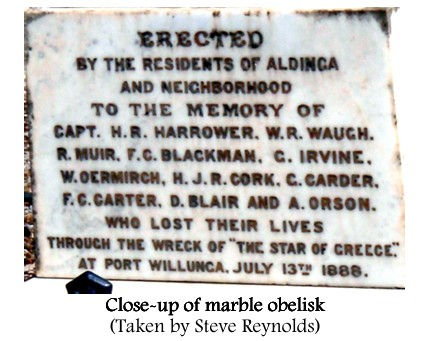
It is 39 years since the Star of Greece was wrecked at Port Willunga, and a ruthless sea has removed all trace of the ill-fated vessel. In a little cemetery attached to the Methodist Church at Aldinga, however, there is a monument which will serve to keep alive the memory of the ship, even as the anchor of Moana will keep alive the memory of the Nashwauk. The inscription on this monument reads: —
Erected by the residents of Aldinga and neighborhood to the memory of Capt. H. R. Harrower, W. R. Waugh, R. Muir, F. C. Blackman, G. Irvine, W. Oermirch, H. J. R. Cork, G. Garder, F. C. Carter, D. Blair, A. Ogson. Who lost their lives through the wreck of the Star of Greece at Port Willunga, July 13, 1888.
(This list does not account for some 5-7 more people whose bodies were not recovered from the wreck.)
I asked the Microsoft Copilot AI Assistant about whether Robinson Road at Seaford may have been named after WC Robinson’s family at all. The response was, “Most likely, yes — that Robinson Road is connected to the same Robinson family who lived and farmed around Moana and Pedler Creek. The evidence isn’t fully digitised, but the pattern of landholding, timing, and location lines up strongly with W. C. Robinson and his sons.”
Further, “W. C. Robinson (often appearing as Wm. C. Robinson or W. Charles Robinson) held or leased land near Pedler Creek and Moana. He had several sons, some of whom continued farming in the district. The family appears in agricultural show results, vineyard reports, and local ratepayer listings from the early 1900s.
Their land sits exactly in the corridor that later became Seaford Rise and Seaford Heights. This makes the Robinsons one of the few families whose holdings align geographically with the modern road. …..”


Comments