
The Anchors on Display at Port Elliot
Updated: Jan 24
There are four large anchors on display close to the Port Elliot jetty (or Horseshoe Bay jetty) in Horseshoe Bay. (These anchors were apparently previously displayed near the Port Elliot Surf Lifesaving club rooms.) A bigger, fifth anchor is located, away from the jetty, at The Cutting above the Horseshoe Bay car park.

I have a copy of an undated newspaper cutting stating, “Two anchors have been recovered from Horseshoe Bay after about 130 years in the sea.” Assuming that these two anchors were lost between the years 1853-1864, they may have been recovered between 1983 & 1994.
“The anchors are believed to be from the brig Harry and the schooner Athol.
The vessels were two of seven wrecked in the bay in the mid-1800s.
A local diver, Mr David Ratcliffe, found the anchors near Commodore Point on Monday and floated them to the surface with 44-gallon drums.”
The Society for Underwater Historical Research’s John Perkins book “The Shipwrecks of Port Elliot 1853-1864” was published in 1988. It provides us with many details about the circumstances of the wrecking of the vessels that led to these anchors being found there. It also explains that some of the anchors may have come from the many moorings that were laid there in the 1800s.
A pamphlet published by Heritage South Australia in 2000 also gives us some details. According to the pamphlet, the schooner Commodore dragged anchor in gusty conditions in February 1856. The Commodore had been anchored in an exposed position. Although there was a mooring cable in the bay at the time, it was said to have been inadequate.
The ketch Lapwing drifted inshore during a storm in September 1856. It had been sharing a mooring with the Swordfish. The Josephine L’Oizeau was wreck in July 1856 after it had mistakenly shackled to the buoy chain instead of the mooring cable. Some new moorings were laid down in October 1856. The brigantine Athol dragged its anchors and was grounded in March 1864.
According to the book “The Shipwrecks of Port Elliot 1853-1864”, a breakwater meant to extend from Freeman’s Knob to Pullen Island to close the southern entrance to Horseshoe Bay only extended some 150m. This provided little protection to ships from heavy seas. Heavy seas would break over the breakwater and portions of it were soon dislodged into the bay.
“The Shipwrecks of Port Elliot 1853-1864” says that two sets of moorings were laid in the lee of Pullen island in 1852. They comprised four 59 cwt anchors (less stocks).These two moorings were not successful so, in 1854, another set were laid in the inner harbour, near the jetty. These new moorings comprised of 22 cwt anchors. These, however, were raised again 12 months later.
In September 1854 and May 1855, sets of moorings were placed inside Horseshoe Bay. The outer moorings (1854) had two 15 cwt anchors. The inner moorings (1855) had 12 cwt anchors. These moorings were later replaced (November 1856?) with a single heavier set that were attached to a 4-ton single-fluked anchor at one end. The other end was fastened around the north-west rock of the ‘Sisters’.
The 21-ton schooner Emu was destroyed after dragging its anchor during high seas, and possibly snapping the anchor cable, in 1853. The Emu had been unable to shackle onto a mooring cable.
The schooner Commodore’s anchor cable parted, and the ship struck the rocks in 1856. The brigantine Josephine L’Oizeau was secured to moorings in the shelter of the breakwater when its cable parted and the ship was driven ashore in July 1856. As stated earlier, it had mistakenly shackled to the buoy chain instead of the mooring cable. New moorings were laid down in October 1856.
The schooner Flying Fish let go an anchor during a south-westerly gale before becoming “a total loss embedded in the sand above high-water mark” in 1860.
The Athol is said to have let go a 3rd anchor during strong gales. It dragged its anchors during a stormy night, drifted into shallow water and was grounded.
Members of the Society for Underwater Historical Research (SUHR) found an anchor at Commodore Point with a 2360mm shanks and a broken fluke, possibly from the Athol. Two anchors were found in the lee of Pullen Island with shanks 1550mm and 2300mm long.
Could those two anchors be the ones referred to in my copy of an undated newspaper cutting that stated, “Two anchors have been recovered from Horseshoe Bay ….. The anchors are believed to be from the brig Harry and the schooner Athol.”?
“The Shipwrecks of Port Elliot 1853-1864” features this photo of one large recovered anchor:-

By early 1990, five anchors were in hand at Port Elliot. According to the Times (Victor Harbor) Fri 23 Feb 1990, “Port Elliot anchors return -
Five anchors which have been retrieved from the rocks off Horseshoe Bay in recent years will soon be mounted in various positions around the Bay. Local historian Lorraine Pomery (Pommery?) arranged for the anchors to be treated with preservative by the Department of Environment and Planning Historic Shipwrecks Unit, a process which has nearly been completed. The anchors, which were previously displayed near the Port Elliot Surf Lifesaving club rooms were taken down three years ago for restoration.
At the last Port Elliot and Goolwa District Council meeting the Port Elliot Town and Foreshore Improvement Association was granted permission to install the anchors on the reserve near the Life Saving Clubrooms as a "lasting monument to the history of the Bay " The association proposed to mount the four smaller anchors of a similar size on a plinth near the clubhouse and jetty, with a plaque describing the history of the Bay. The fifth - much larger anchor will be placed on the site of the old harbourmaster’s anchors cottage, overlooking Horseshoe Bay."
I have photos of the five anchors on display at Port Elliot. Here, firstly, are the four anchors located near the jetty: -

This is the large mooring anchor on display at The Cutting: -

According to this plaque accompanying the large mooring anchor, it was recovered in 1956:-

Here are each of the four individual anchors near the jetty: -
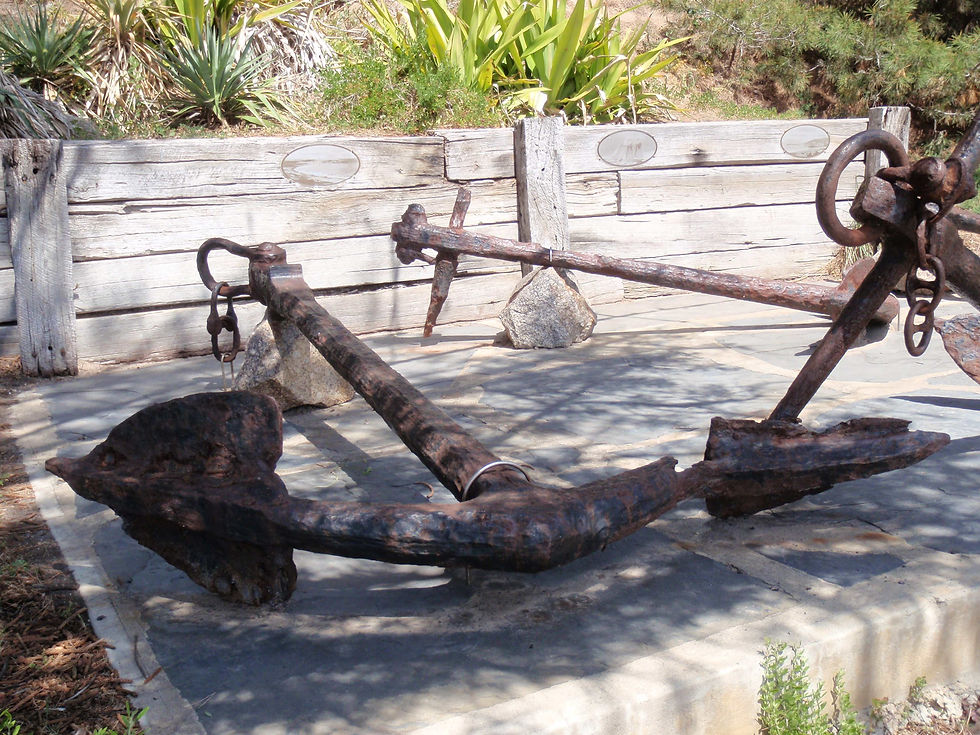


There are a couple of anchors there with broken or missing flukes. It woukd be nice to be able to identify the source (vessel) for any, or all, of the individual anchors. It is possible that the last one shown above is the same anchor featured here in “The Shipwrecks of Port Elliot 1853-1864”: -


Comments