
Shipwrecks in the Philippine Islands
Shipwrecks in the Philippine Islands
I was given a T-shirt gift from the Philippines for this year’s Father’s Day: -

It features nine shipwrecks in the Philippine Islands. The Olympia Maru, Morazan and Kogyo Maru are all said to be cargo vessels/ships. (The Kogyo Maru is said to be an auxiliary cargo ship.)
The Akitsushima is said to be a seaplane tender. The Irako is said to be a refrigerated ship. The Kyokuzan Maru is said to be a supply vessel (freighter). The Okikawa Maru is said to be an oil tanker.
The East Tangat is said to be a submarine craft. The Lusong Gunboat is said to be a coastal vessel.
According to Wreck Diving Around Coron (in the Philippines), “There are over ten diveable shipwrecks in the area. Each wreck has its own story and unique features:”
The Okikawa Maru is a “massive oil tanker covered in beautiful hard and soft corals and has a lot of fish swimming around it.”
The Akitsushima is a “warship (seaplane tender) that lies on its side. You can still see giant gears and mechanisms from the crane used to lift the planes.”
The Lusong Gunboat is one of the best shallow wrecks for beginners. It “sits in very shallow water (0 to 12 metres). The top of the ship is visible at low tide. It is perfect for beginners, snorkelers, and underwater photographers who want bright, natural light.”
The East Tangat is also one of the best shallow wrecks for beginners. It is a “small tugboat (which) starts at just 3 metres deep and goes down to 19 metres. It is very calm and easy to explore.”
(Some of the shallow wrecks, such as the Lusong Gunboat, are very close to the surface.
There are also some deeper wrecks which offer incredible rooms to penetrate.)
The Irako is a “large Japanese refrigeration ship. It is very intact and considered one of the best wreck dives in Asia. ….. The deck sits at around 28 metres, and the bottom goes down to 43 metres. (It is one of the best deep wrecks for advanced divers, and it requires deep diving skills.)
The Kogyo Maru is an “auxiliary supply ship lying between 22 and 36 metres deep. It has large cargo holds containing construction materials like cement bags and a bulldozer. This is also one of the best deep wrecks for advanced divers.
Those six wrecks are part of the nine listed on my T-shirt gift from the Philippines: -
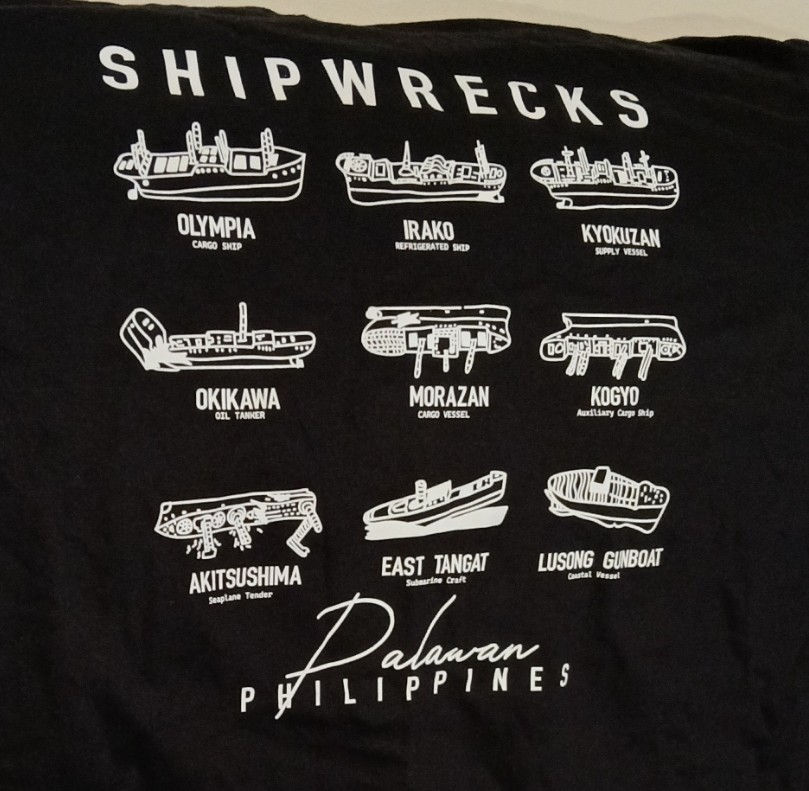
(The Kogyo Maru appears to be on its side.)
According to Coron Dive Guide, “Coron delivers Southeast Asia’s finest WWII wreck diving across 10-12 Japanese vessels sunk in 1944, now thriving artificial reefs at 10-43 meters.” It gives details about most of the above-mentioned wrecks.
There are three other wrecks on my T-shirt that have not yet been mentioned. These are:
The Olympia Maru (cargo ship)
The Kyokuzan (supply vessel)
The Morazan Maru (cargo vessel)
The Morazan Maru appears to be on its side. According to The Ultimate Guide to Wreck Diving in Coron, “the Morazan Maru (is) ideal for Open Water divers who want their first taste of wreck exploration.”
It is listed as being a “Passenger-Cargo (ship), 12–26m, Beginner-Friendly (dive), Great for training, natural light.”
The Olympia Maru is listed as “Cargo (ship), 18–30m, Intermediate (dive), Easy access, lionfish galore.”
According to Kyokuzan Maru Shipwreck, the “Kyokuzan Maru shipwreck (is) …. Max. depth 42 m. This impressive Japanese freighter measures about 136m long and lies almost upright. The main structures remain intact. It carries in one of its holds a car and truck. This wreck provides shelter to batfishes and substrate for the ubiquitous bivalves. Fusiliers, trevallies, barracudas and rays are occasionally seen.”


Comments