
The Display of an 18th Century Cast Iron Muzzle Loading Swivel Gun
This 18th century cast iron muzzle loading swivel gun is on display in the SA Maritime Museum in Port Adelaide: -

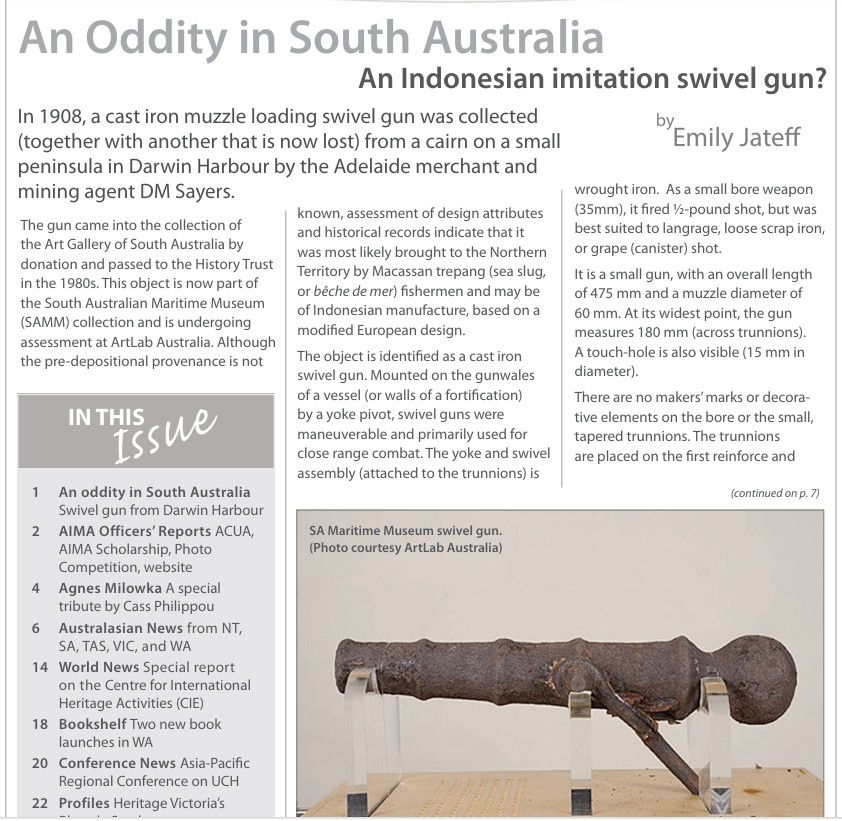
Details about its discovery and eventual display were published in the Australasian Institute for Maritime Archaeology’s AIMA Newsletter for March 2011, Vol.30, No.1. The article titled “An Oddity in South Australia – An Indonesian Imitation Swivel Gun?” by Emily Jateff starts on page 1: -

The article continues on pages 7-8. Here are the 3 pages: -


According to “Southeast Asian Cannon Making in Negara Brunei Darussalam” (2012) by Ahmad Safwan Jalil from Flinders University Department of Archaeology, “So-called ‘Southeast Asian cannon’ are unique artillery artefacts that are widely distributed across the Southeast Asia region. These cannon usually are identified as a type of swivel gun, are heavily decorated and typically have a tubular cascabel into which a tiller is inserted for handling.”
The SA Maritime Museum’s Manager Curatorial, Adam Paterson provided us with the photo of the swivel gun and the following HTSA object record: -
Accession No: HT 1993.0085
Accession Lot: AGSA Transfer W2 – AGSA Transfer W2:Donor
IRN: 118008
Division: MM
Collection: Objects
Sub Collection: Weapons
Tertiary Classification: cannon
Multimedia Images: Title: HT93.85.jpg
Creation (1)
Earliest Date Created: 01/01/1601
Latest Date Created: 31/12/1799
Earliest Use Date: 01/01/1701
Latest Use Date: 31/12/1799
Creation (2)
Subject Classification 1: EUROPEAN
Subject Classification 2: WEAPONS
Significance: Part of the Historical Relics Collection, it demonstrates a continuing connection between South Australia and the Northern Territory (once part of South Australia) and highlights the record of interaction between Australia and Southeast East. As an object, it is unique. No similar object has been located. It may be indicative of Southeast Asian modification of European guns, or provide insight into use of these weapons by Macassan fishermen operating off of the Northern Territory from the 17-19th centuries. Swivel guns such as these were mounted on the sides of Macassan praus (fishing vessels) as a deterrent to pirates. They were also used as defensive weapons for small fortifications.
Provenance: In 1908, a cast iron muzzle loading swivel gun was collected (together with another that is now lost) from a cairn on a small peninsula in Darwin Harbour by the Adelaide merchant and mining agent DM Sayers. It came into the collection of the Art Gallery of SA by donation and passed to the History Trust in the 1980s. The object is now included within the South Australian Maritime Museum collection (transferred from Migration Museum in 2009). After the gun was found by Mr D.M. Sayers a photograph of it was forwarded to Lieutenant-General Sir Edward Hutton with a request that Sir Edward would endeavour to obtain an expert’s opinion as to the probable age of the gun. The photograph was then forwarded to Lord Dillon, The Armouries, Tower of London, who wrote back that it was “evidently a ship gun with its crutch. The heavy breech would greatly facilitate the moving an aiming of the piece. Unfortunately there is no scale to show of what calibre the gun is. It appears to have been a muzzle loading pierrier or patterera of … the late 17th century. The rings on it represent the old rings shrunk on the guns when made longitudinally placed bars.” It is possible that the gun may have belonged to Buccaneers who frequented the North West Coast of Australia near the end of the 17th Century.
Physical Description: The object is identified as a cast iron swivel gun. Mounted on the gunwales of a vessel (or walls of a fortification) by a yoke pivot, swivel guns were manoeuvrable and primarily used for close range combat. The yoke and swivel assembly is wrought iron. As a small-bore weapon (35mm), it fired 1/2 pound shot, but was best suited to langrage, loose scrap iron, or grape (canister) shot.
Material 1: Iron
Material 2: mounted in a Perspex showcase
Material 3: wood base
Height 1: 95
Width 1: 180
Depth 1: 475
Diameter 1: 60
Unit Length 1: mm
Current Location: [Bond Store: First Voyages] SAMM – Bond Store – Upper Floor – First Voyages: Exploring the Southern Coast
Condition Status: 5. Poor
Condition Details: Heavily rusted, poor condition.
(Some minor detail has been left out.)
(This topic only came up whilst I was investigating another topic. I was trying to track down a student study that may have been done on the two bronze cannon at the Royal South Australian Yacht Squadron.
I had been told that an international (possibly Asian) Flinders Maritime Archaeology student may have recorded or analysed these cannon as part of an Honours, Masters, or coursework project. I di not get to find out anything about that matter at all, but this topic seemed to be the nearest clue.)
(My thanks go to both Wendy Van Duivenvoorde from Flinders University and Adam Paterson from the SA Maritime Museum for their assistance in this topic.)


Comments