
The wreck of the Ketch Tickera
In M͏a͏y͏ ͏2͏0͏2͏5͏, The South Australian Ketch Fleet took a look back at the ketch Tickera. They said that the Tickera was built by Taylor and Hamilton, Port Adelaide*, in 1910 for a Mr Walter Dorey, of Tickera, the district between Port Broughton and Wallaroo in SA.
* (Birkenhead)
“The vessel was 65 feet long, by 17 feet beam, by 4.9 feet deep. Tickera was double ended, and built on the same construction method as many Murray River Paddle Steamers and barges, i.e. a composite vessel, with steel frames, topsides, and deck, with hardwood timber bolted to the steel frames at the turn of the bilge, to form a completely flat bottom. A large centreboard, common to nearly all of the trading ketches, enabled her to sail to windward without crabbing off to leeward.
“The reason she was built this way was to enable her to take the bottom at low tide, without damage, to load at the tidal beaches where there were no loading facilities. A steel bottom could very easily be damaged on the uneven ground when loaded.
“Tickera traded until the early 1960’s, when she was sold to Mac Lawrie, stripped down, and used to carry concrete bridge sections and other material in the construction of the Torrens Island Power Station. Once this was done, the ship was beached somewhere in the North Arm, and left to the elements.
“Tickera was at one time owned by Paul Strauss, or “Deutcher” as the ketch fraternity called him. He often sailed the Tickera on his own to one of the little ports on the eastern side of Yorke Peninsula, load the ship on his own, with 800 bags of barley, each weighing 186 pounds, or 86 kilograms, some of which was on his hands and knees with a bag on his back, as the ship wasn’t deep enough to stand up in, and sail her back to Port Adelaide.
“….Tickera was a handy little ship, a smart sailor, and served her owners well.”
Dorothy Vernon Smith took this photo of the Tickera at No. 4 berth: -
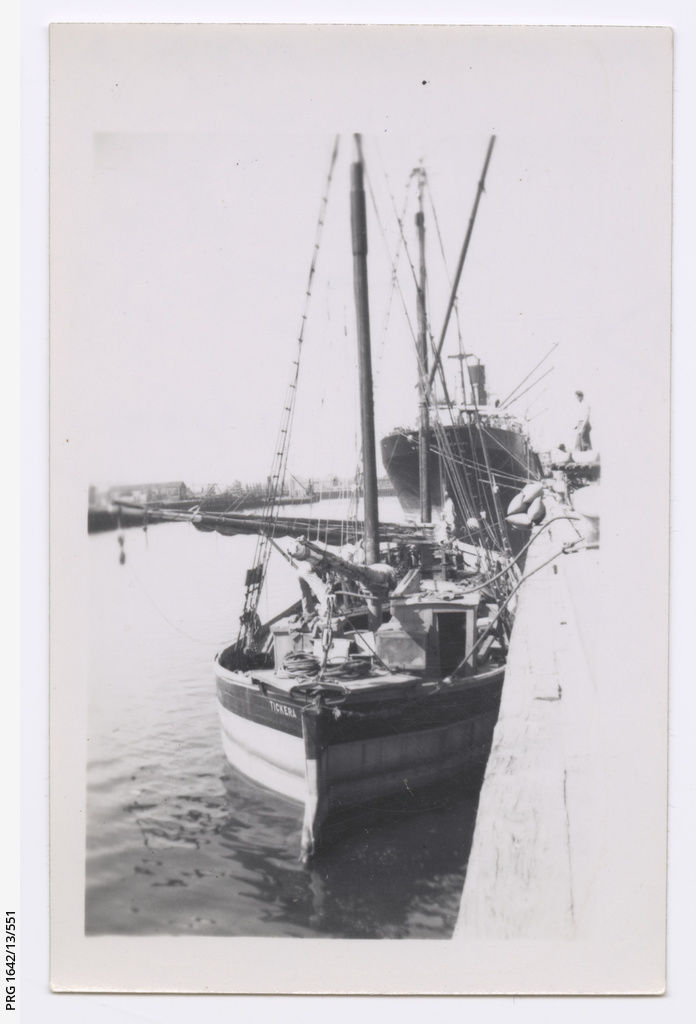
The 'Tickera' (ketch) at No. 4 berth, where it is fuelling and working cargo.
(Tickera at No. 4 berth [PRG 1642/13/551], taken by Dorothy Vernon Smith*, Part of the State Library of South Australia Vernon Smith Collection and the Port Adelaide Collection)
* (Dorothy was the daughter of Vernon Smith – see https://mlssa.org.au/2026/11/10/bernard-cotton-vernon-smith-the-shiplovers-society/)
The State Library of SA suggests that this photo from part of the Port Adelaide Collection “appears to be the small trading ketch "Tickera" (in Port Adelaide)”: -

Sailing vessel that appears to be the small trading ketch "Tickera" (in Port Adelaide)
(Photo courtesy of the State Library of South Australia, Port Adelaide [B 20792], Part of Port Adelaide Collection)
Back in September 2026, Chris Frizell had asked me to find the remains of the Tickera, which he said had been abandoned in the North Arm of the Port River. That was news to me since the Tickera is not listed in any of the wreck lists for the Ships’ Graveyard in the North Arm.
“Ketches of South Australia” by Ronald Parsons stated that the Tickera had once been owned by an M. Lawrie as a diving tender in 1964. I took that to mean the late Mac Lawrie, a salvage diver based in Port Adelaide. I was able to contact Mac’s son, Jock to ask him what he knew about the Tickera.
“Are there any remains of the Tickera ketch left in the North Arm graveyard that you know of? If so, can they be found?” I asked Jock.
His reply was, “My understanding is Tickera was in very poor condition when my father owned it & it was eventually cut up for scrap somewhere around at the North Arm, probably cut up by the scrap metal dealer at the time named Jimmy Clay. Unfortunately my father never really explained to me the story with Tickera. My understanding is Tickera was composite built so not sure what would (have) happened to the timber remains.”
According to “Ketches of South Australia”, the Tickera was a composite-built, two-masted ketch whose Official Number was 122729. As already stated above, its dimensions were 65.0 x 17.0 x 4.9 feet and built in 1910 by Taylor and Hamilton at Birkenhead, SA.
Walter Dorey was Tickera’s first owner in 1910. Edward Wright became the owner by 1919. J. (Jack?) Heritage was the owner in 1923. A 18bhb auxiliary engine was fitted to the vessel in that year (1923). R.M. Crouch and partners became the owner by 1941. A (Captain) Paul Strause* became the owner after R.M. Crouch and partners.
* (Earlier spelled as ‘Straus’ in the book and spelled as ‘Strauss’ by The South Australian Ketch Fleet.)
As The South Australian Ketch Fleet said, “Tickera was at one time owned by Paul Strauss, or “Deutcher” as the ketch fraternity called him”, and he often sailed the Tickera on his own, a statement repeated in “Ketches of South Australia”.
“He often sailed the Tickera on his own to one of the little ports on the eastern side of Yorke Peninsula, load the ship on his own, with 800 bags of barley, each weighing 186 pounds, or 86 kilograms, some of which was on his hands and knees with a bag on his back, as the ship wasn’t deep enough to stand up in, and sail her back to Port Adelaide.”
Tickera was sold to Mac Lawrie in 1964 to be used as a diving tender for Mac’s salvage diving work. The very next year, however, Tickera was sold “to a building contractor for use in demolition work in connection with Torrens Island power house scheme”.
The very next year again, the Tickera sank (in 1966) and was sold for demolition itself. It was reportedly dragged on to the bank of the North Arm where it was dismantled. It is quite possible that it was dismantled close to the Torrens Island Power Station in the North Arm, rather than amongst the numerous vessels in the Garden Island Ships’ Graveyard in the North Arm.
There is just a slim chance that any possible remains of the Tickera may be one of the vessels to be found in Angas Inlet on the banks of Torrens Island, a matter that I continue to investigate.
According to AI, “The Tickera is one of those vessels that seems to sit in the gap between the well-documented Garden Island wrecks and the many working craft that were simply broken up and disappeared from the record. Sometimes the absence of a vessel from the official graveyard inventories is itself an important clue, suggesting dismantling rather than abandonment as an intact hulk.”
In order to find any possible remains of the Tickera, AI suggests: -
Consider checking:
“Harbors Board disposal records.
The South Australian Register of Shipping and Ketches.
Aerial photographs from the late 1940s and 1950s.
Any surviving photographs of Tickera during her final years.”
“If you eventually uncover a disposal date, there is a good chance we could correlate it with aerial imagery of Garden Island and perhaps even identify where she was dismantled.”
Re those images to be found at https://collections.slsa.sa.gov.au/resource/PRG+1642/13/551 and https://collections.slsa.sa.gov.au/resource/B+20792, the Microsoft Copilot AI Assistant said: -
“Those two State Library images are actually quite useful because they help bracket Tickera's working life.
The earlier photograph, Port Adelaide [B 20792], is dated approximately 1901. The catalogue notes that "according to a researcher, the sailing vessel appears to be the small trading ketch 'Tickera'."
The later photograph, Tickera at No. 4 berth [PRG 1642/13/551], is dated 19 August 1947 and explicitly identifies the vessel as the ketch Tickera "fueling (sic) and working cargo" at No. 4 Berth, Port Adelaide.
“What I find most significant is the 1947 image. It shows Tickera still actively employed rather than laid up or derelict. If she was subsequently dismantled in the Garden Island area, the disposal must have occurred after August 1947, because the State Library photograph documents her still trading at that date.
“That may explain why she does not readily appear among the classic Garden Island Ships' Graveyard hulks, many of which were abandoned much earlier. A vessel still working in 1947 could easily have been sold, stripped, and broken up rather than becoming a long-lived visible wreck.
“The next historical question is therefore not "where was Tickera abandoned?" but rather "when was Tickera removed from service and how was she disposed of after 19 August 1947?" The answer is likely to be in Harbors Board records, shipping registers, or newspaper notices from the late 1940s and 1950s.
“The 1947 photograph is probably the latest firmly dated evidence of Tickera that we currently have.”
These four photos come courtesy of The South Australian Ketch Fleet’s Facebook page: -


(Photos courtesy of The South Australian Ketch Fleet’s Facebook page, Source https://www.facebook.com/photo/?fbid=1006983154880324&set=pcb.1006983188213654 )


Comments